The Staff Project

Categories
Blog

AI Literacy for Teachers in 2026: The Skill That Will Define Your Career

AI Literacy for Teachers in 2026

The Skill That Will Define Your Career

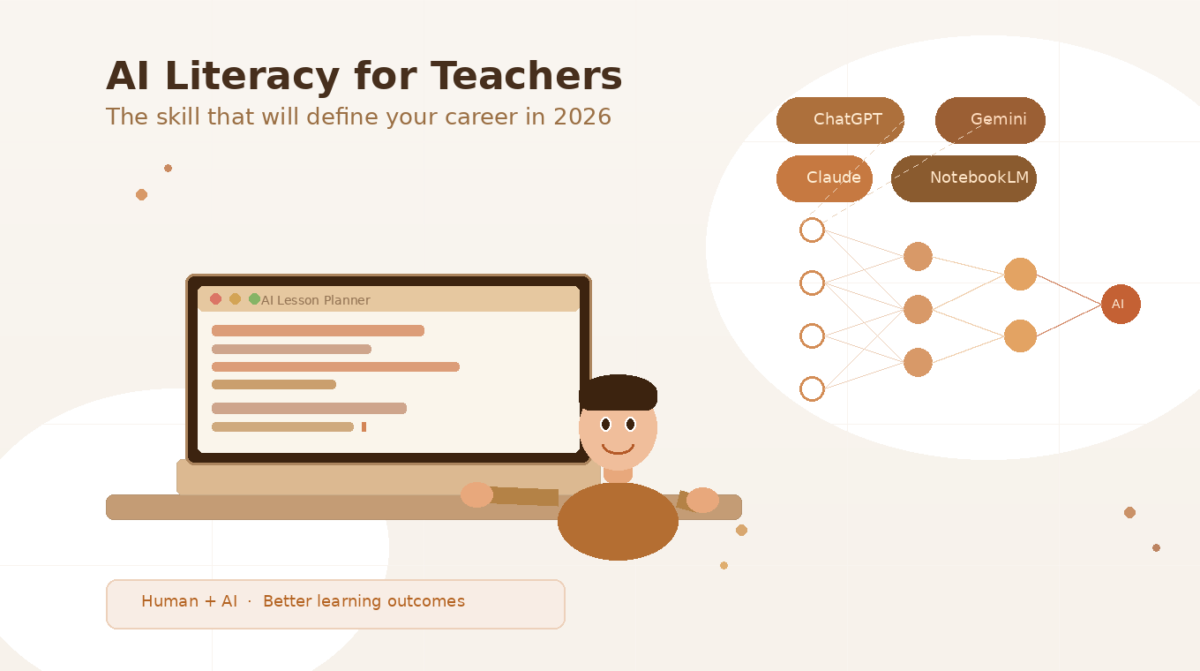
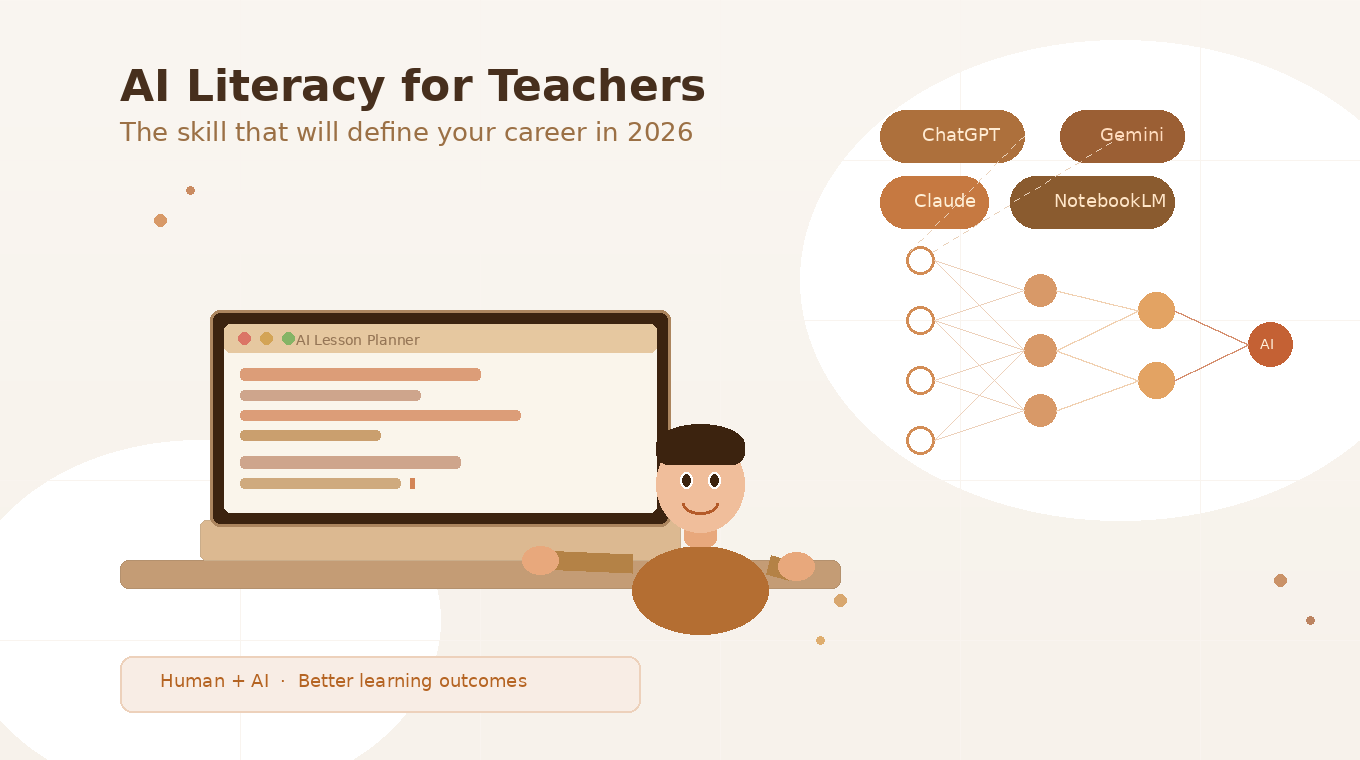
Three years ago, teachers were asking, “Is AI cheating?” In 2026, school leaders are asking, “How are you using AI to improve learning outcomes?” The shift is not coming—it’s already here. If you want to stay competitive in international and high-end private schools, AI literacy is no longer optional. It is your new superpower.

Moving Beyond the Chatbot

What AI Literacy Actually Means

AI literacy isn’t just about generating poems or answers. For a modern educator, it involves three core competencies:

From 4 Hours to 15 Minutes

The Efficiency Revolution

What AI Actually Saves You (Real Classroom Comparison)
TaskThe Manual Way (Pre-2024)The AI-Literate Way (2026)
Lesson Planning2 hours of searching and typing5 mins: Generate a differentiated plan instantly
Grading Rubrics1 hour of formatting2 mins: AI creates structured rubrics
Parent Emails15 mins per email1 min: Draft polished responses
Resource CreationHours making PPTs/worksheets10 mins: Auto-generated slides & summaries
2026

The 2026 “Big Four” Teaching Partners

01

ChatGPT: The Creative Draft Engine

Use it when you're stuck planning the next day’s lesson.

Best for: Lesson planning, brainstorming, and content creation

02

Google Gemini: The Guided Learning Tutor

Gemini works well as a student-facing support tool.

Best for: Student tutoring and guided problem-solving

03

Claude: The Nuanced Writing Partner

Claude excels in high-quality, human-like communication.

Best for: Feedback, communication, and long-form writing

04

NotebookLM: The Research Powerhouse

Upload your curriculum, and it becomes an expert on your material.
Best for: Research, revision, and curriculum mastery

AI

Teaching Students to Use AI Responsibly

AI-literate teacher

As an AI-literate teacher, your role shifts from gatekeeper to guide.

Schools are looking for educators who can:
Example:
Instead of simply submitting an essay, students can:
Conclusion

Keeping the Human in the Loop

AI will not replace teachers.
But teachers who use AI will replace those who don’t.

The real impact of AI is not automation—it is liberation.

It removes the repetitive workload so teachers can focus on what truly matters: mentoring, inspiring, and connecting with students.

Ready for

Future-Forward Teaching Opportunities?

Join The Staff Project Teacher Network and get matched with leading schools across Bangalore and beyond.

Send your CV to: jobs@thestaffproject.com

FAQs

AI literacy is the ability to effectively use AI tools for teaching, planning, evaluation, and student engagement.

Popular tools include ChatGPT, Google Gemini, Claude, and NotebookLM.

Yes, most schools encourage responsible AI use to enhance learning outcomes and efficiency.

Categories
Blog

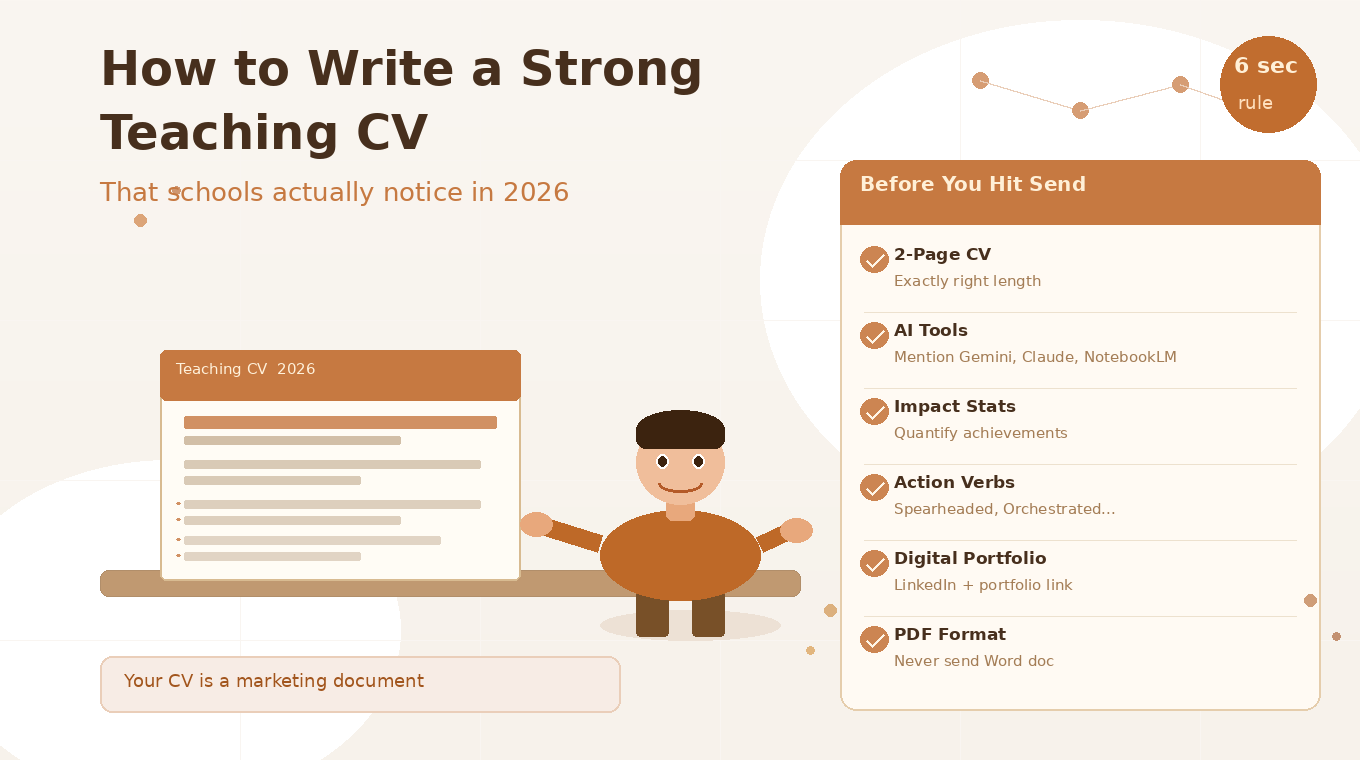
How to Write a Strong Teaching CV (That Schools Actually Notice)

How to Write a

Strong Teaching CV (That Schools Actually Notice)

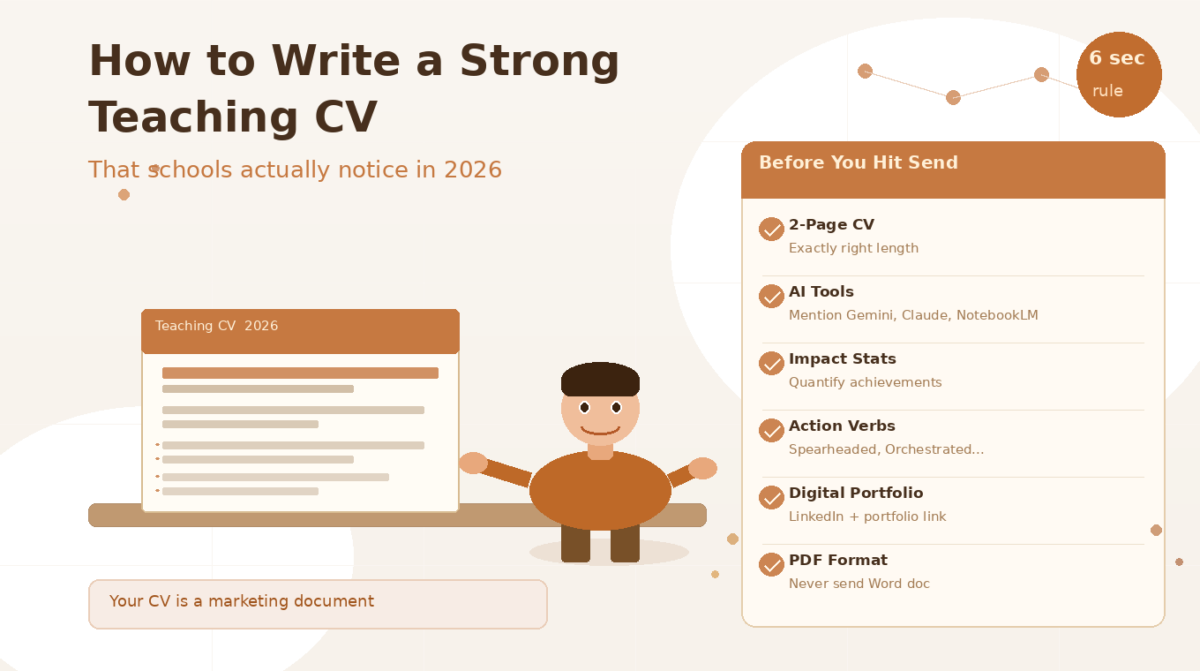
In 2026, the "standard" teaching CV is dead. With international schools receiving hundreds of applications per role, your CV has exactly 6 seconds to make an impression before a recruiter moves on—or an AI filter Archive it. To get noticed by top-tier schools (IB, Cambridge, or elite K-12), your CV needs to prove you are more than just a subject expert; it needs to show you are an impact-driven, tech-fluent educator.

The 2026

"Must-Haves" for Your Header

recruiters in 2026 look for immediate “credibility markers.” Ensure your header includes:

Showcasing

"AI Literacy" & Modern Pedagogy

Schools are currently obsessed with how teachers handle the AI revolution. Dedicate a specific section to Modern Teaching Competencies:

AI

Focus on Impact, Not Responsibilities

The biggest mistake teachers make is listing their job description. Schools already know what a teacher does; they want to know what you achieved.

Instead of saying…

Say this (The 2026 Way)…

“Responsible for teaching Grade 10 Physics.”

“Led 95% of Grade 10 students to ‘A’ grades through flipped classroom models and virtual labs.”

“Attended workshops on IB pedagogy.”

“Implemented IB Category 1 strategies to redesign the Year 4 Science unit, increasing student engagement by 30%.”

“Managed classroom behavior.”

“Implemented a restorative justice framework that reduced classroom disruptions by 40%.”

01

Format for the "6-Second Rule"

Recruiters and ATS (Applicant Tracking Systems) love clean, scannable layouts.
02

Board-Specific Tips (IB/ICSE/Cambridge)

Tailor your CV to the specific "vibe" of the school board:
03

The "Checklist" Before You Hit Send

Final Thought: Your CV is a marketing document, not a biography. Its only job is to get you the interview. By highlighting your 2026-ready skills, you’re telling schools that you aren’t just keeping up with the future—you’re leading it.

04

Looking for Teaching Opportunities?

Join The Staff Project Teacher Network and get connected with leading schools across Bangalore and beyond.

👉 Submit your CV at jobs@thestaffproject.com and be considered for relevant roles.

Categories
Blog

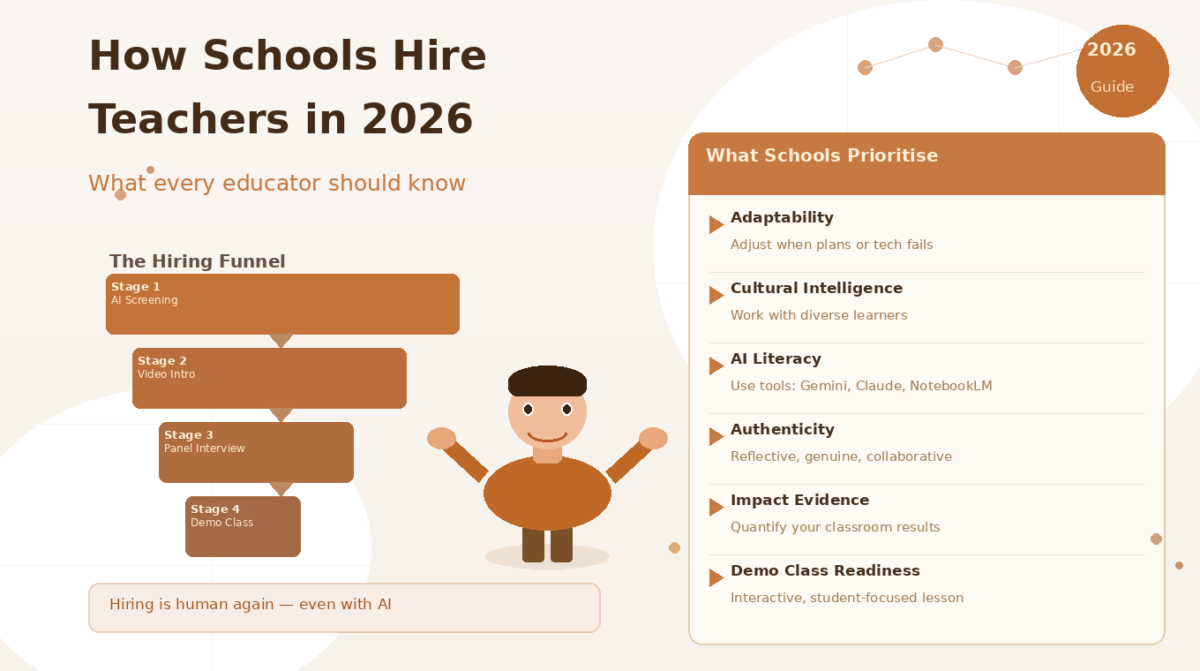
How Schools Hire Teachers in 2026: What Every Educator Should Know

How Schools Hire Teachers in 2026

What Every Educator Should Know

If you’ve applied for a teaching role recently and felt the process was different—you’re right. In 2026, the global teacher shortage and the rise of AI have reshaped how schools find, screen, and select talent. Hiring is faster, more data-driven, and far more focused on who you are in the classroom—not just what’s on your CV. Understanding this new recruitment funnel can be the difference between a generic rejection and a signed contract.

2026

The 2026 Hiring Funnel: From AI to Persona

Modern schools—especially international and premium K–12—use a multi-stage hiring funnel.

01

Stage 1 : AI Screening (ATS)

Applicant Tracking Systems scan for power skills, not just degrees.

What gets you shortlisted:

👉 If your CV doesn’t include these, you may never reach a human reviewer.

02

Stage 2: Asynchronous Video Introduction

Many schools request a 1–2 minute video before scheduling interviews.

Quick tip: Keep it natural, structured, and under 90 seconds.

03

Stage 3: Panel Interview

This is where cultural fit is evaluated.

04

Stage 4: Live Demo Class

This is the final and most decisive stage.

What Schools

Really Prioritise in 2026

Your degree (B.Ed, PGCE) gets you in the door—but it doesn’t get you the job.

Schools are hiring for:

💡At The Staff Project, we consistently see schools choosing adaptable, reflective teachers over “perfect-on-paper” candidates.

The Demo Class

Has Changed (It’s Now Conversational)

The traditional 45-minute lecture is outdated.

In 2026, demo lessons are shorter, interactive, and student-focused.

What schools actually observe:
Pro Tip:
If the school is tech-forward, include a small interactive element:

👉 This signals that you’re future-ready without overcomplicating the lesson.

Interview Questions:

Expect Real Scenarios

Forget “What are your strengths?”

Interviewers now focus on real classroom situations.

Example questions:
Best strategy: STAR + Reflection

Red Flags That Get Candidates Rejected

Even strong candidates are rejected for behavioural signals.

Common red flags:
Conclusion:

Hiring Is Human Again

The 2026 hiring process may be powered by AI—but it is deeply human at its core.

Schools are not looking for perfect teachers.

They are looking for educators who are:

If you understand the process, you can position yourself to succeed at every stage.

Looking for

Teaching Opportunities?

Join The Staff Project Teacher Network and get matched with leading schools across Bangalore and beyond.

📩 Send your CV to: jobs@thestaffproject.com

FAQs

Most schools use ATS systems to scan CVs for skills, keywords, and relevant experience before human review.

Yes—demo lessons are often the final deciding factor in hiring.

Adaptability, communication, cultural intelligence, and real classroom impact.

Categories
Blog

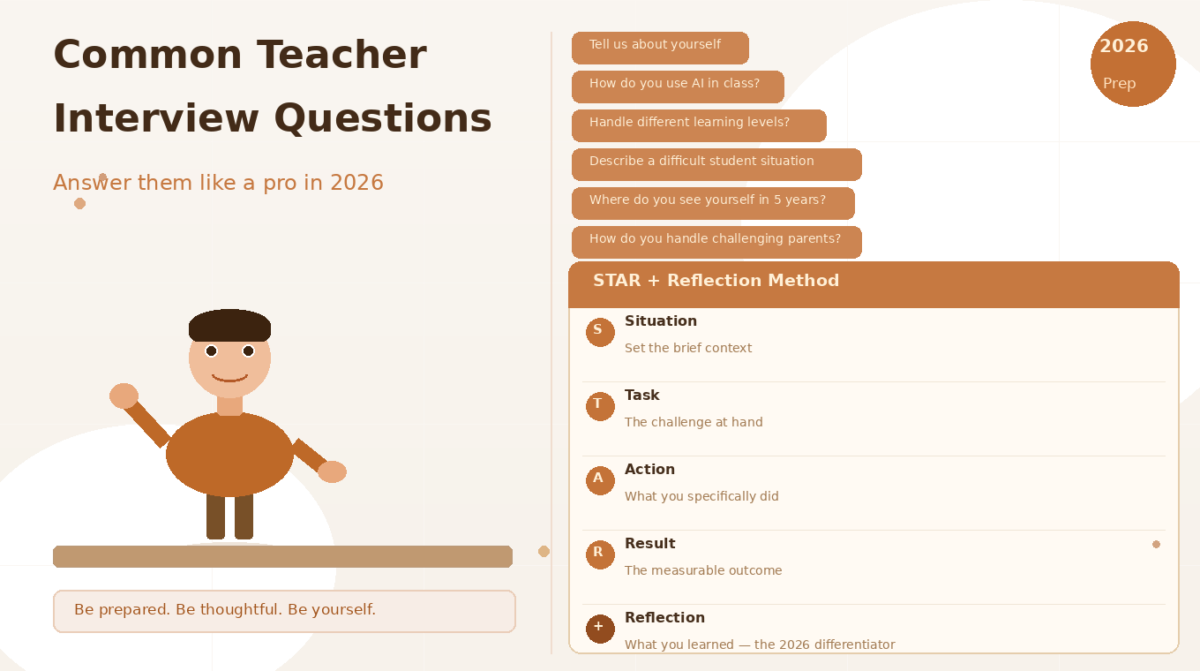
Common Teacher Interview Questions in 2026 (And How to Answer Them Like a Pro)

Common Teacher Interview

Questions in 2026 (And How to Answer Them Like a Pro)

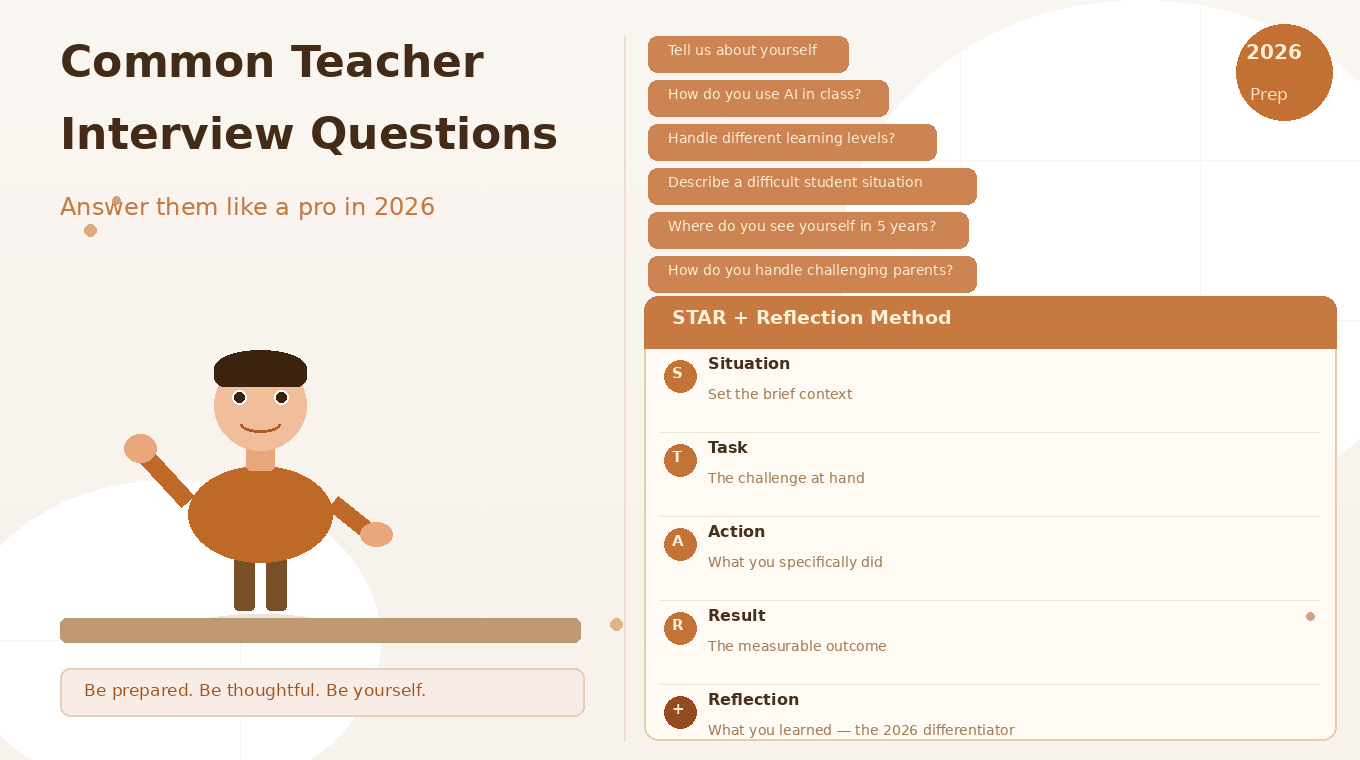
The teaching interview in 2026 is no longer about memorising theory. Schools today are assessing something far more important: your real-time decision-making in a diverse, tech-enabled classroom. They want to know—can you think, adapt, and respond like a modern educator? If you have an interview coming up, here are the most common questions you’ll face, what interviewers are actually evaluating, and how to answer them effectively.

“Tell Us About Yourself”

(The Culture Fit Check)

What they’re really assessing:
How to answer:

Structure your answer in 3 parts:

Strong Example:
“Professionally, I’m an educator who focuses on inquiry-based learning and student voice. Outside the classroom, I enjoy trekking and reading about cognitive science. My family is very supportive of my career, and we’re excited to be part of a school community that values both innovation and wellbeing.”

“What Do You Know

About Our School?” (Intentionality Test)

What they’re really assessing:
How to answer:

Strong Example:
“I noticed your focus on integrated STEM and sustainability initiatives like your Green Campus project. I also saw how students are using technology for real-world problem-solving. That aligns strongly with my belief in connecting classroom learning to real-world impact.”

“How Do You Use AI Responsibly in the Classroom?”

What they’re really assessing:
How to answer:

Position AI as a tool for thinking, not shortcutting.

Strong Example:
“I treat AI as a co-pilot. For example, students may use AI to generate ideas or perspectives, but their task is to evaluate, refine, and validate that information. This shifts the focus from content generation to critical thinking.”

“How Do You Handle Different Learning Levels in One Class?”

What they’re really assessing:
How to answer:

Use a tiered or flexible learning approach.

Strong Example:
“I use tiered tasks where the core concept remains the same, but the complexity varies. I also incorporate guided learning tools and extension activities so that both struggling and advanced learners stay engaged.”

“Tell Us About a Difficult Student Situation” (SEL Check)

What they’re really assessing:
How to answer:

Reframe behaviour as a need, not a problem.

Strong Example:
“I see students as ‘disengaged’ rather than difficult. In one case, I used a restorative approach, worked with the student to set expectations, and gave them a structured responsibility. Over time, their engagement improved significantly.”

“How Do You Handle Challenging Parents?”

What they’re really assessing:
How to answer:

Lead with empathy and data.

Strong Example:
“I focus on building a partnership. I listen to the parent’s concerns, then share student progress with concrete examples. This helps shift the conversation from disagreement to collaboration.”

“Where Do You See Yourself in 5 Years?”

What they’re really assessing:
How to answer:

Show ambition within the school ecosystem.

Strong Example:
“In five years, I see myself growing into a mentor role, contributing to curriculum development, and possibly leading initiatives around innovation or student wellbeing within the school.”

The STAR + Reflection Method (Your Secret Weapon)

Structure your answers using this framework:

👉 The reflection is what sets 2026 candidates apart.

Conclusion:

Be Real, Not Perfect

Schools have seen hundreds of polished answers.

What they are looking for now is authenticity.

Be prepared. Be thoughtful. But most importantly—be yourself.

That’s what makes a teacher memorable.

Looking for

Teaching Opportunities?

Join The Staff Project Teacher Network and get matched with leading schools across Bangalore and beyond.

📩 Send your CV to: jobs@thestaffproject.com

FAQs

Questions usually focus on classroom management, differentiation, AI usage, and parent communication.

Prepare real examples, practice structured answers, and understand modern teaching trends like AI and SEL.

Yes, many schools now expect basic familiarity with AI tools and how they support learning.

Categories
Blog

How to Get a Job in International Schools in 2026: A Step-by-Step Guide

How to Get a Job in International Schools in 2026

A Step-by-Step Guide

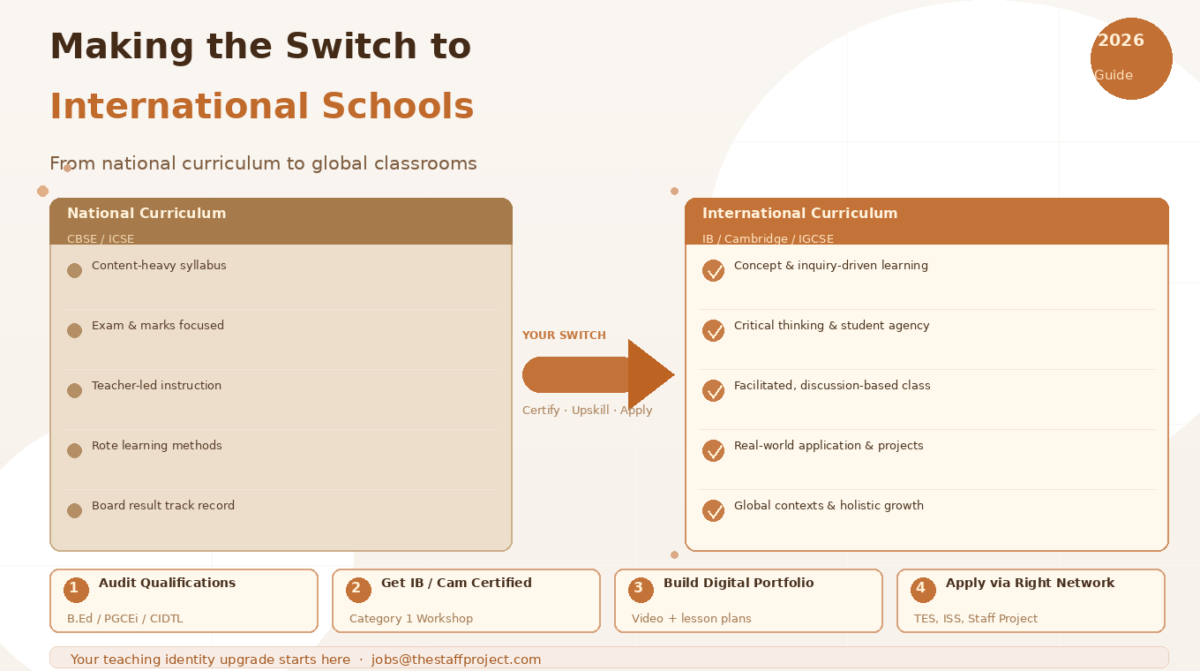
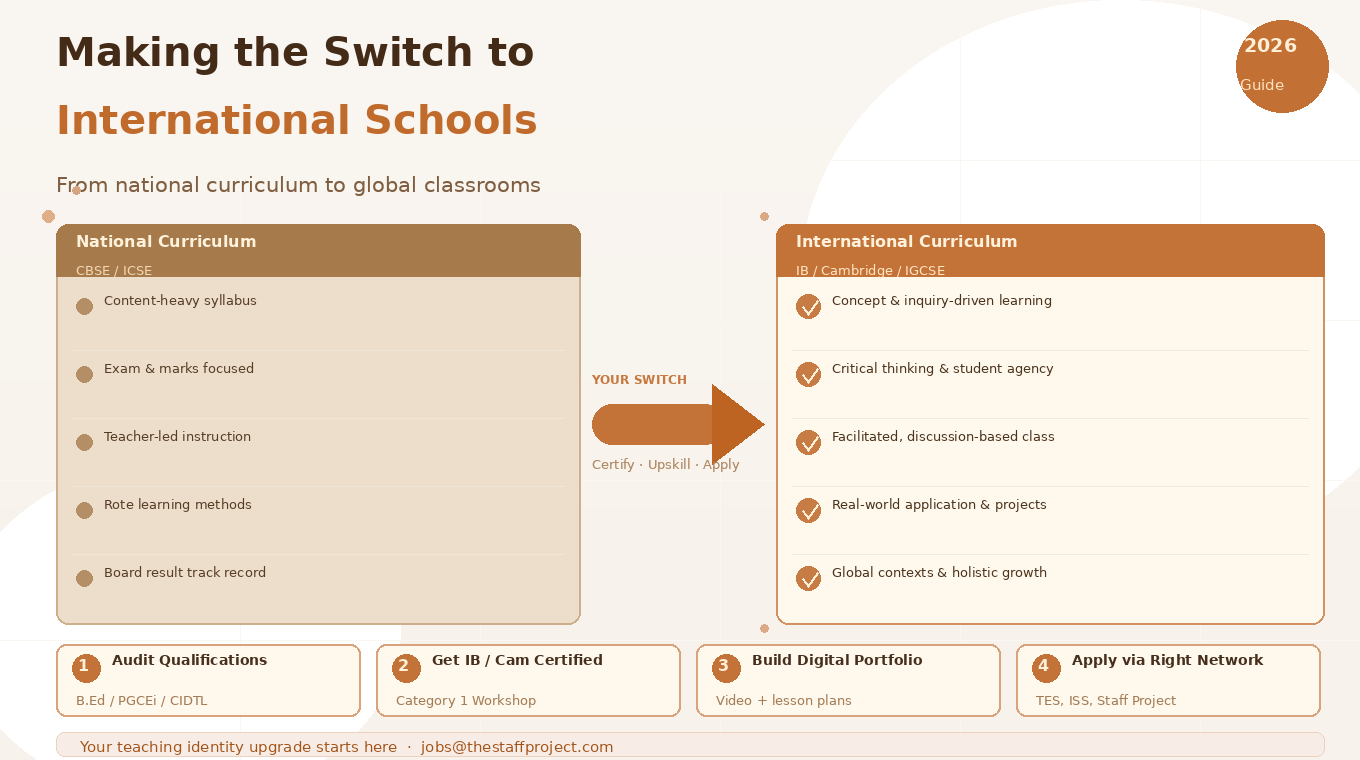
The “International School” dream—better pay, global exposure, and modern pedagogy—is more achievable in 2026 than ever before. But making the shift from CBSE/ICSE to IB or Cambridge isn’t automatic. It requires a clear strategy, the right certifications, and a mindset shift. If you’re planning this transition, here’s your step-by-step roadmap.

01

Step 1: Audit Your Qualifications

Before applying, check if you meet the baseline expectations.

Minimum requirements:

👉 Think of this as your eligibility filter before entering the global market.

02

Step 2: Choose Your Curriculum Path (IB vs Cambridge)

Avoid applying randomly—each curriculum has a distinct philosophy.

IB (International Baccalaureate)
Cambridge (IGCSE/A Levels)

👉 Choose based on your teaching style—not just availability.

03

Step 3: Shift to an Inquiry-Based Mindset

This is the biggest transition challenge.

What needs to change
How to demonstrate this:
2026 Edge:

Highlight how you use tools like AI or digital platforms to support self-directed learning.

04

Step 4: Build a Digital Teaching Portfolio

Your CV alone is no longer enough.

Include:

👉 This is what makes recruiters remember you.

05

Step 5: Know Where to Look (Hidden Job Market)

Most international school roles are not advertised traditionally.

Where to search:

💡We regularly connect teachers with international and premium schools looking for future-ready educators.

Tip

Pro Tip: The “Bridge Year” Strategy

If Tier-1 schools feel out of reach, don’t stop.

Look for dual-curriculum schools (CBSE + IB/Cambridge).

Why this works:

👉 This is one of the smartest entry strategies in 2026.

Conclusion:

Upgrade Your Teaching Identity

Moving to an international school is not just a job switch—it’s a professional upgrade.

When you align your:

You become a strong candidate for global opportunities.

🚀 Ready to Transition to

International Schools?

Join The Staff Project Teacher Network and get matched with leading schools across Bangalore and beyond.

📩 Send your CV to: jobs@thestaffproject.com

FAQs

Start with IB training, shift to inquiry-based teaching, and gain relevant experience.

It’s the minimum, but certifications like PGCEi or CIDTL improve your chances.

Yes, most prefer 2–3 years, but entry roles are available for beginners.

Categories
Blog

Why Using a Recruitment Consultant Beats Applying Directly in 2026

Why Using a Recruitment

Consultant Beats Applying Directly in 2026

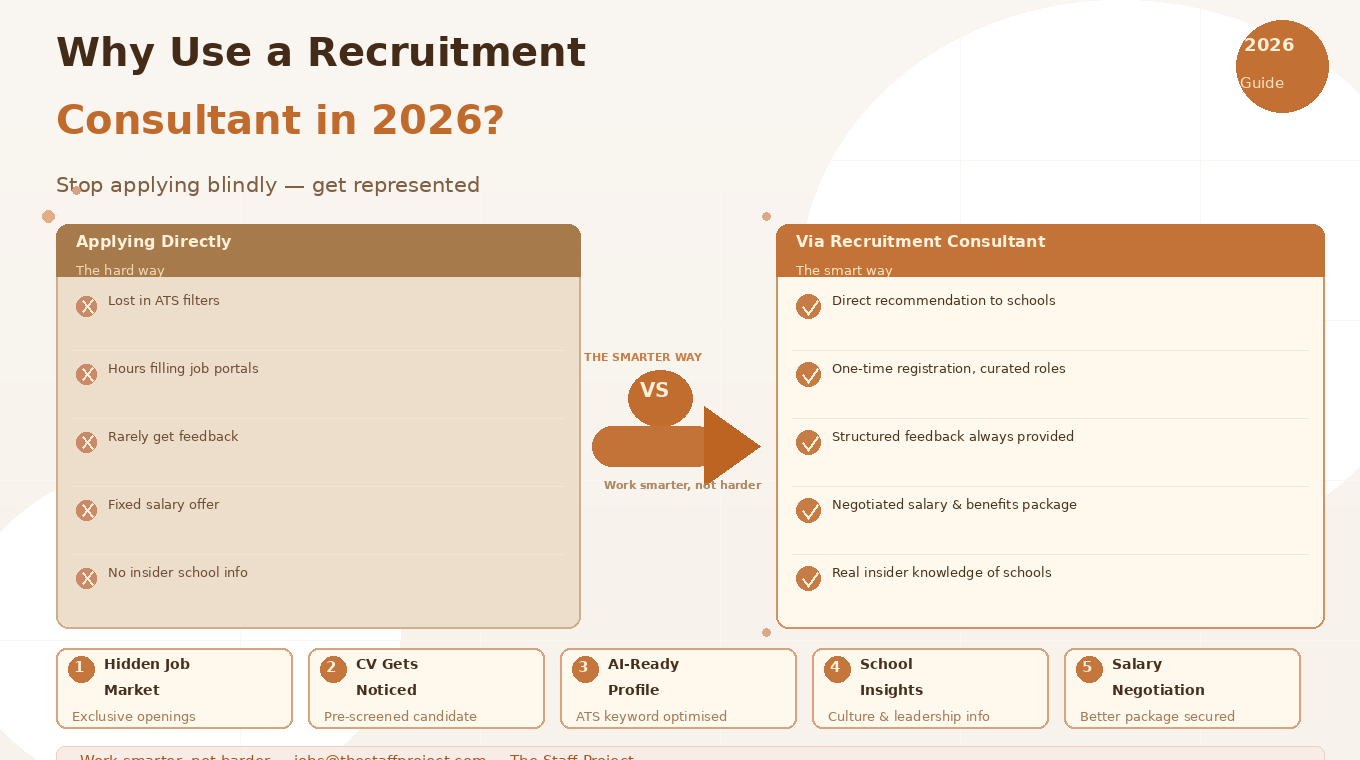
In today’s competitive teaching market, there are two ways to find your next role. You can spend hours applying on job portals, filling repetitive forms, and waiting for responses… Or you can work with a recruitment consultant who actively matches you with the right opportunities. In 2026, the most successful educators are choosing the second path.

01

Access to the Hidden Job Market

Many top schools don’t advertise their best roles publicly.

Why?

To avoid being flooded with irrelevant applications.

The Consultant Advantage:

👉 This gives you a first-mover advantage.

02

Your CV Doesn’t Get Lost

When you apply directly, your CV competes with hundreds of others—and often gets filtered by AI.

The Consultant Advantage:

👉 You go from “one of many” to “pre-screened candidate.”

03

AI-Ready CV & Profile Optimisation

In 2026, schools look for more than experience—they look for impact and AI literacy.

The Consultant Advantage:

👉 This ensures your profile aligns with what schools actually want.

04

Real Insights About Schools

Websites show the ideal version of a school—not the real one.

The Consultant Advantage:

👉 Helps you avoid poor-fit environments.

Stress-Free

Salary Negotiation

Most teachers feel uncomfortable negotiating salaries.

The Consultant Advantage:

👉 You get what you deserve—without awkward conversations.

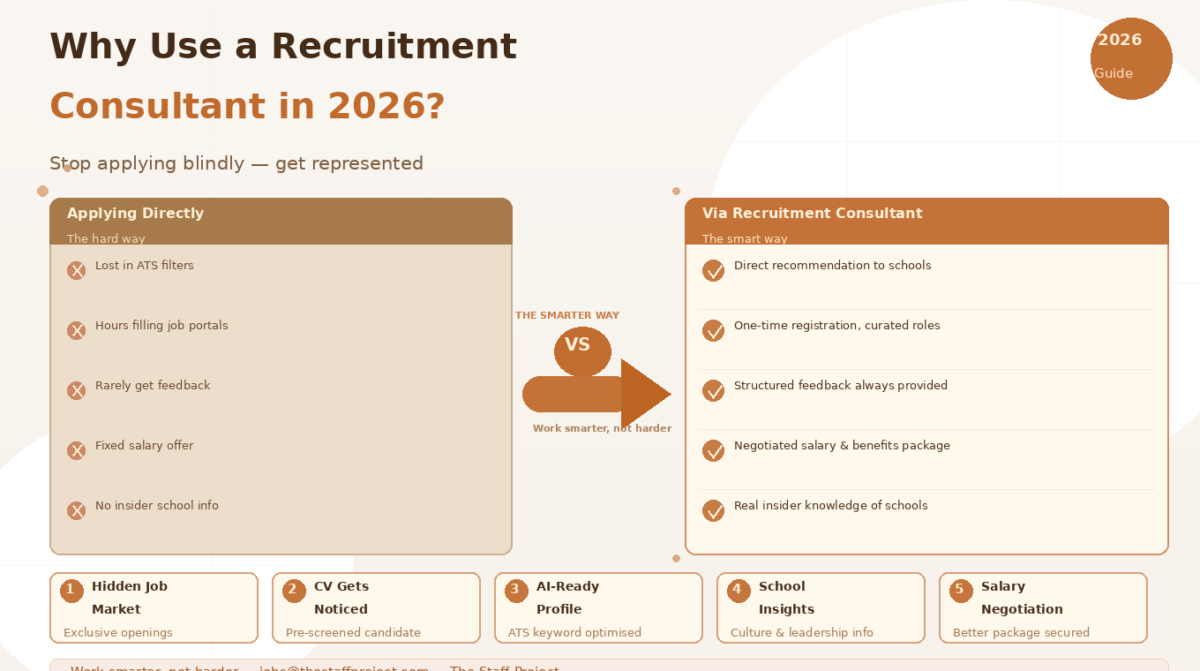
Direct vs Consultant:

The 2026 Comparison

Feature

Applying Directly

Via Consultant

Visibility

Lost in ATS systems

Direct recommendation

Time

Hours of applications

One-time registration

Feedback

Rarely provided

Structured feedback

Salary

Fixed offer

Negotiated package

Preparation

Self-guided

Expert coaching

Conclusion:

Work Smarter, Not Harder

In 2026, job searching shouldn’t feel like a full-time job.

Working with a consultant means:

You’re not just applying—you’re being represented.

🚀 Ready to Find

the Right Teaching Opportunity?

Join The Staff Project Teacher Network and let our consultants match you with the right schools.

📩 Send your CV to: jobs@thestaffproject.com

FAQs

Most education consultants are paid by schools, not candidates.

Using a consultant often improves visibility, feedback, and negotiation outcomes.

Yes, many provide mock interviews, CV guidance, and insider insights.

    For Schools — Hiring Inquiry

    Tell us about your school

    Share a few details and we'll get in touch to understand your requirements.

    School Name

    Your Name & Role

    Email

    Phone / WhatsApp

    Curriculum

    Positions to Fill

    Or reach us at jobs@thestaffproject.com· +91 98450 14434

      For Educators — Free, Always

      Apply with us

      Share your details and we'll reach out when the right opportunity arises.

      Full Name

      Email

      Phone / WhatsApp

      Current Role & School

      Subject & Curriculum

      submit resume

      Anything else?


      Or email your CV to jobs@thestaffproject.com