
What Every Educator Should Know
If you’ve applied for a teaching role recently and felt the process was different—you’re right. In 2026, the global teacher shortage and the rise of AI have reshaped how schools find, screen, and select talent. Hiring is faster, more data-driven, and far more focused on who you are in the classroom—not just what’s on your CV. Understanding this new recruitment funnel can be the difference between a generic rejection and a signed contract.
2026
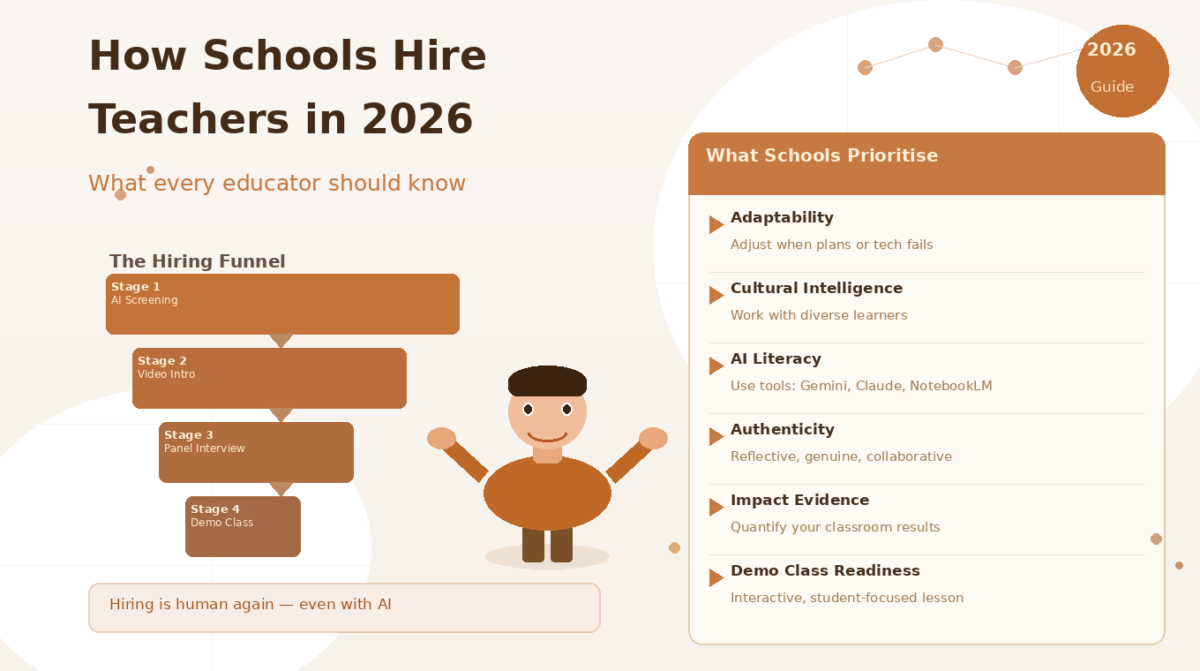
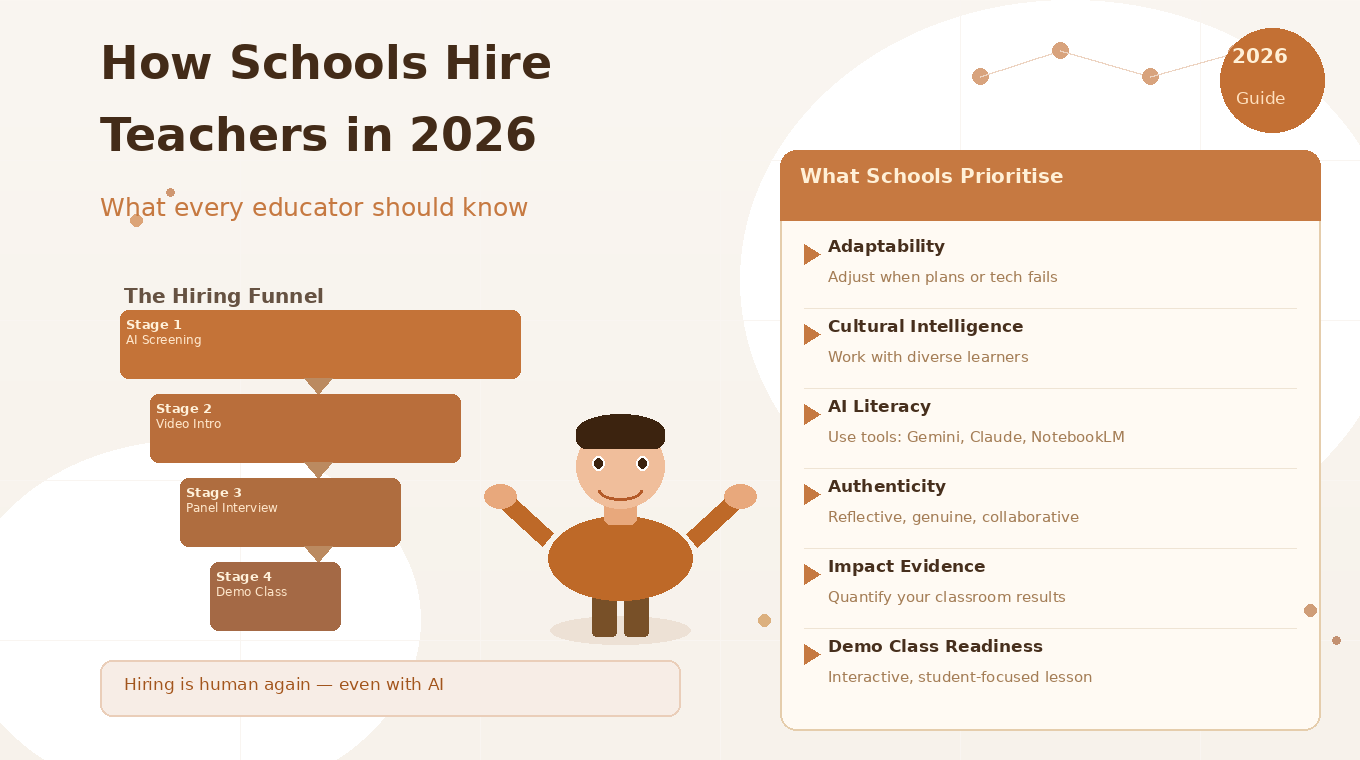
The 2026 Hiring Funnel: From AI to Persona
Modern schools—especially international and premium K–12—use a multi-stage hiring funnel.
Stage 1 : AI Screening (ATS)
Applicant Tracking Systems scan for power skills, not just degrees.
What gets you shortlisted:
- Inquiry-Based Learning
- Social-Emotional Learning (SEL)
- Differentiated Instruction
- AI Literacy
👉 If your CV doesn’t include these, you may never reach a human reviewer.
Stage 2: Asynchronous Video Introduction
Many schools request a 1–2 minute video before scheduling interviews.
- Communication clarity
- Classroom presence
- Energy and authenticity
Quick tip: Keep it natural, structured, and under 90 seconds.
Stage 3: Panel Interview
This is where cultural fit is evaluated.
- Expect questions around collaboration, student engagement, and your role in the wider school community.
Stage 4: Live Demo Class
This is the final and most decisive stage.
- Your teaching philosophy is tested in real time.
What Schools
Really Prioritise in 2026
Your degree (B.Ed, PGCE) gets you in the door—but it doesn’t get you the job.
Schools are hiring for:
-
Adaptability
Can you adjust when plans change or technology fails? -
Cultural Intelligence
Can you work with diverse learners across backgrounds and abilities? -
Authenticity
Are you genuine, reflective, and collaborative—or overly rehearsed?
💡At The Staff Project, we consistently see schools choosing adaptable, reflective teachers over “perfect-on-paper” candidates.
The Demo Class
Has Changed (It’s Now Conversational)
The traditional 45-minute lecture is outdated.
In 2026, demo lessons are shorter, interactive, and student-focused.
What schools actually observe:
- How you ask questions
- How you respond when a student is stuck
- How you check for understanding during the lesson
Pro Tip:
- Quick poll
- Think–pair–share activity
- AI-assisted brainstorming (e.g., guided prompts)
👉 This signals that you’re future-ready without overcomplicating the lesson.
Interview Questions:
Expect Real Scenarios
Forget “What are your strengths?”
Interviewers now focus on real classroom situations.
- “A student submits an AI-generated essay and claims it’s original. What do you do?”
- “How do you challenge both high-achieving and struggling students in the same lesson?”
Best strategy: STAR + Reflection
- Situation – Set the context
- Task – What was required
- Action – What you did
- Result – What happened
- Reflection – What you learned (this is the 2026 differentiator)
Red Flags That Get Candidates Rejected
Even strong candidates are rejected for behavioural signals.
-
Speaking negatively about previous schools
Signals poor professionalism -
Rigidity
Resistance to new tools, platforms, or AI integration -
Low confidence or overwhelm
Schools want resilience, not perfection
Conclusion:
Hiring Is Human Again
The 2026 hiring process may be powered by AI—but it is deeply human at its core.
Schools are not looking for perfect teachers.
They are looking for educators who are:
- Reflective
- Adaptable
- Student-centered
- Ready to grow
If you understand the process, you can position yourself to succeed at every stage.
Looking for
Teaching Opportunities?
Join The Staff Project Teacher Network and get matched with leading schools across Bangalore and beyond.
📩 Send your CV to: jobs@thestaffproject.com
FAQs
Most schools use ATS systems to scan CVs for skills, keywords, and relevant experience before human review.
Yes—demo lessons are often the final deciding factor in hiring.
Adaptability, communication, cultural intelligence, and real classroom impact.